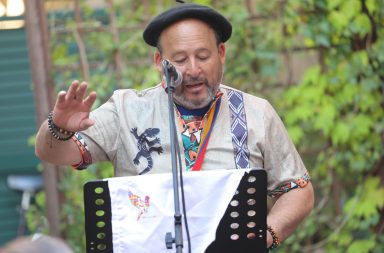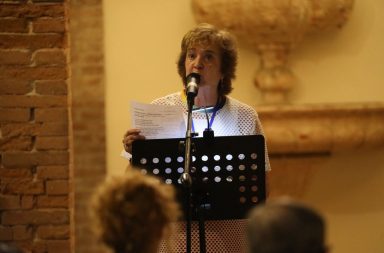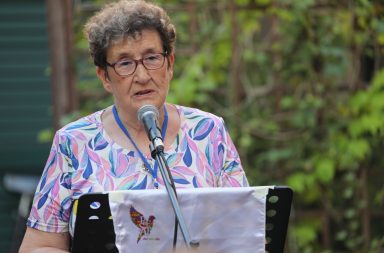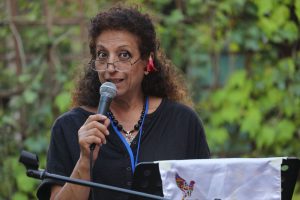
Fotografía: Lucio Russo — Miraggio di Lux / Semplicità del Caos
Índice de contenidos
ToggleRajaa Gharbi’s participation in the II International Meeting of Poets of the World in Italy, held from June 12 to 20, 2026, was part of a larger poetic dialogue between America, Europe and Africa.
Her presence in Italy brought together several dimensions that are deeply connected to her poetry: different cultures, languages, memories and ways of looking at the world.
In Ferrara, Rajaa presented her poem “Altars in Unfuturistic Dwellings”, which she read in English, while an Italian artist performed the Italian reading. This encounter between languages was more than a simple translation. It became an artistic dialogue in which the same poetic work could live in two languages and reach different audiences.
But what lies behind Rajaa Gharbi’s poetry? What experiences and searches make her writing such a distinctive voice?
Watch Rajaa Gharbi reading her poem “Altars in Unfuturistic Dwellings” during the meeting in Italy.
1. Poetry is born from a life between cultures
One of the fundamental characteristics of Rajaa Gharbi’s work is that her poetry does not belong exclusively to one territory.
Her life has developed between Tunisia, Morocco, the United States and other places where she has carried out artistic activities. This experience of movement and cultural encounter becomes creative material.
For Rajaa, borders are not only geographical lines. There are also borders between languages, cultures, memories and ways of seeing the world.
Poetry allows her to cross those borders.
2. Between languages and different voices
Language occupies an important place in Rajaa’s poetic experience.
Reading a poem in one language and hearing it interpreted in another creates a space where cultures can meet without one having to disappear.
This was particularly evident during the meeting in Ferrara. Rajaa read “Altars in Unfuturistic Dwellings” in English, while an Italian artist brought the poem to the Italian-speaking audience.
The experience demonstrated one of the great possibilities of poetry: words may change language, but their emotional and human meaning can continue to cross borders.
3. Poetry as a meeting place
The Italian encounter was not simply a succession of poetry readings.
Throughout nine days, poets, writers, artists and cultural figures from different countries shared experiences in Rome, Florence, Bologna, Ferrara, Rovigo, Mestre and Venice.
Rajaa’s participation became part of this international exchange, where poetry functioned as a meeting place between people who come from different cultural realities.
In this sense, her presence in Italy reflected one of the essential principles of Poets of the World: using poetry to create bridges between peoples.
4. The journey becomes part of the poem
Travel can change the way we look at the world.
Moving from one country to another means encountering different languages, traditions, landscapes and histories. For a poet, these encounters can become questions, images and emotions that eventually find their way into poetry.
Rajaa’s international experience gives her writing a perspective that is not confined to a single cultural horizon.
Her poetry emerges from encounters.
5. Memory, identity and the contemporary world
The meeting between cultures also raises questions about identity.
Who are we when we live between different places? How does another language change the way we understand ourselves? What happens when memories from different worlds coexist?
These are some of the questions that can be felt behind a poetic work such as “Altars in Unfuturistic Dwellings.”
Rather than offering simple answers, poetry opens spaces for reflection.
6. Poetry beyond geographical borders
The experience in Italy once again demonstrated that poetry can travel.
A poem written in one cultural environment can be read in another country, translated into another language and understood by people who have never shared the poet’s original experience.
That is precisely the power of an international poetry movement.
Poets do not need to speak the same language to recognize one another. They can meet through images, emotions, questions and the common human experiences contained within their work.
7. Rajaa Gharbi in the Poets of the World experience
Rajaa Gharbi’s participation in Italy was therefore more than an individual appearance on a cultural program.
It was part of a collective experience in which poetry became a vehicle for dialogue between America, Europe and Africa.
From Rome to Venice, the II International Meeting of Poets of the World created spaces for encounters, readings, conversations and friendships. In Ferrara, Rajaa’s poem crossed yet another border: from English into Italian.
That moment summarizes something essential about poetry itself.
A poem can begin in one place and continue its journey somewhere else. It can pass from one language to another, from one culture to another, and still retain the ability to speak to human beings.
Rajaa Gharbi’s voice became part of that journey in Italy.
And perhaps that is one of the most beautiful things about poetry: it does not ask where we come from before inviting us to listen to one another.
Poetry knows no borders
The participation of Rajaa Gharbi in the II International Meeting of Poets of the World in Italy reminds us that poetry remains a powerful space for cultural encounter. This meeting was part of the new stage of Poets of the World, following the celebration of its 20th anniversary and the launch of its new website.
In a world divided by borders, conflicts and differences, poets can continue to create bridges.
Rajaa brought her voice to Italy.
Italy gave that voice another language.
And poetry, once again, crossed the border.
Because poetry knows no borders.