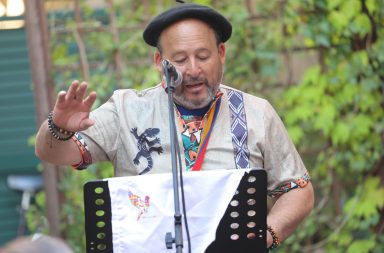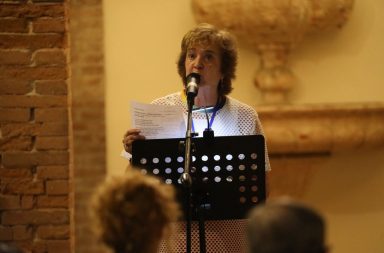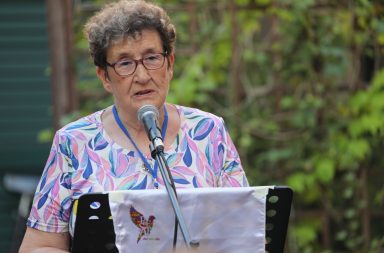
Fotografía: Lucio Russo — Miraggio di Lux / Semplicità del Caos
Óscar René Benítez in Italy became part of the II International Meeting of Poets of the World, bringing to Italy a body of work shaped by memory, love, nature and concern for the destiny of humanity.
There are poets who write from a territory. Others write from the distance that separates human beings from that territory.
Óscar René Benítez belongs, to a great extent, to thissecond category.
Salvadoran-American and a resident of Los Angeles, his literary journey has developed between two worlds that do not necessarily exclude each other: the country of origin and the country of residence, memory and the present, Latin American identity and the experience of living in a multicultural society.
In June 2026, that voice crossed borders once again to meet other voices from around the world in Italy, during the II International Meeting of Poets of the World, a nine-day journey through Rome, Florence, Bologna, Ferrara, Rovigo, Mestre and Venice.
Óscar René Benítez arrived at this meeting not only as an invited poet. His presence also had a special significance within the international structure of the movement: he currently serves as Vice President of Poets of the World for the Americas.
Watch Oscar René Benitez in Italy sharing his poetry during the II International Meeting of Poets of the World.
Óscar René Benítez: a journey between literature and culture
The literary history of Óscar René Benítez is extensive and crosses different genres.
His work includes poetry and narrative. Among his books of poetry are Te cantó mi corazón, Sollozos en el viento, 30 poemas de amor para María, Versos de otoño, Cuando caiga la noche, Al filo del ocaso, Al paso de las horas and Murmullos del silencio.
He has also published the bilingual anthology The Old Maple Tree, in Mandarin Chinese and English.
As a novelist, he is the author of Cuando concluyó la guerra, Las huellas de una lucha sin final and Inmortales, the latter also published in Mandarin Chinese.
His career has been recognized in different literary settings. In 1983 he obtained second place in the Simón Bolívar poetry contest, and in 1984 he won the Benito Juárez contest, both sponsored by the Educational Literary Society of Los Angeles. He was later a finalist in the international Pablo Neruda contest and received a medal from the City of Los Angeles for his cultural contribution.
His work has also circulated beyond the Spanish-speaking world. His novel Inmortales was translated into Mandarin Chinese and published in Taiwan, while The Old Maple Tree appeared in a bilingual English-Mandarin edition.
But behind the books and awards there is another equally important dimension: his work as a cultural promoter and bridge-builder between communities.
His career includes participation in literary meetings, conferences and cultural activities in America and Asia, carrying with him a literature deeply connected to the Latin American experience.
Poetry as a territory of encounter
Óscar René Benítez in Italy represented the meeting of different cultures and literary traditions.
In Italy, Benítez shared the stage with poets from Chile, Colombia, Brazil, Spain, Tunisia, the Democratic Republic of the Congo and Norway.
It was precisely this diversity that gave meaning to the meeting.
It was not simply a matter of bringing authors together to speak about literature. The proposal of Poets of the World is broader: to make poetry a space for human encounter, where cultural, geographical and linguistic differences can become an opportunity to listen to and recognize one another.
For Óscar René Benítez, this experience has a particular resonance.
As a Salvadoran writer living in the United States, his own literary life is marked by cultural displacement and the coexistence of different identities. His poetry has found readers and spaces in different countries and has been part of international initiatives for literary exchange.
In Italy, therefore, he was not representing only one country.
He was also representing that America which lives beyond its borders and continues to carry its memory, its questions and its dreams.
The tree as a symbol of life
Among the texts by Óscar René Benítez presented during this experience was La pesadilla del árbol (The Nightmare of the Tree), a poem that allows us to approach one of the fundamental concerns of his writing: the relationship between human beings and nature.
The poem begins in a forest full of life.
There are birds, insects, wind, rain and trees growing together like brothers. The landscape appears as a living, balanced and almost musical community.
But that harmony is broken.
The men arrive.
And with them comes the noise of chainsaws.
The trees begin to fall and the forest progressively loses its sounds. The birds flee, the animals search for trees that no longer exist, and what was once a space of life becomes a desolate territory.
The poem therefore acquires a dimension that goes beyond the description of the destruction of a forest.
The tree can be read as memory, home, refuge and continuity of life.
When it disappears, it is not only a plant species that disappears: an entire world that depended on it disappears as well.
This sensitivity toward nature coincides deeply with one of the principles that Poets of the World has defended since its foundation: the protection of life and the preservation of the environment.
From love to concern for the world
The journey of Óscar René Benítez in Italy was another chapter in a literary trajectory marked by movement between cultures.
The poetry of Óscar René Benítez, however, is not limited to environmental concerns.
His bibliography shows an important presence of love poetry, while other texts explore memory, the passage of time, the human condition and the wounds of our societies.
In Ecos del fondo, for example, he uses the image of a fish trapped in a fishbowl to construct a powerful reflection on the loss of freedom.
The animal, accustomed to the immensity of the ocean, ends up reduced to a limited existence between four transparent walls.
The image becomes particularly suggestive because the poet is not speaking only about the fish.
In the final verses, he establishes an identification with human beings themselves, also trapped in routines and limitations that can eventually become a form of imprisonment.
Nature, freedom and the human condition therefore appear closely connected.
A poet within an international community
Oscar René Benitez in Italy was, above all, an encounter between poetry, cultures and people. His participation in the II International Meeting of Poets of the World showed once again how poetry can cross borders, connect different cultures and create spaces for dialogue and fraternity.
Since its creation in Valparaíso, Chile, on October 14, 2005, the movement founded by Chilean poet Luis Arias Manzo has sought to bring together writers from different cultures around a humanistic conception of poetry.
In more than two decades, the network has reached 143 countries, bringing together thousands of poets and organizing meetings, readings and cultural activities in different parts of the world.
The purpose is not to build a conventional literary institution, but to maintain an international community where poetry can recover a social and human dimension.
The Universal Manifesto of Poets of the World states that poets should not remain indifferent to humanity’s great challenges and that poetry can contribute to awakening consciousness.
From this perspective, the presence of Óscar René Benítez in Italy takes on a special meaning.
His poetry dialogues with several of the movement’s essential concerns: freedom, nature, memory, dignity and the need to build a different world.
From Los Angeles to Italy
The journey to Italy was, ultimately, another chapter in a trajectory that has taken Óscar René Benítez through different cultural spaces.
On this occasion, the destination was an Italy transformed for nine days into a territory of encounter.
Rome was the beginning. Then came Florence, Bologna, Ferrara, Rovigo, Mestre and finally Venice.
In each city, the poets found hosts, readers, artists and communities.
And in each place something happened that can hardly be measured in statistics: people who until then belonged to different geographies began to recognize themselves as part of the same conversation.
Benítez arrived from the United States, carrying with him the memory of El Salvador and the Latin American literary tradition. Others arrived from Africa, Europe, Brazil, Colombia, Tunisia and Chile.
The languages could be different.
The stories could be different as well.
But there was a common concern: what can poetry do in the face of a world that seems to be progressively losing its ability to listen?
Óscar René Benítez in Italy was, above all, an encounter between poetry, cultures and people.
Perhaps one of the answers was found precisely in that encounter.
The word that continues to travel
When the II International Meeting of Poets of the World came to an end, the participants returned to their respective countries.
But international meetings do not necessarily end when the last event is over.
The words continue to travel.
They travel through the books exchanged, the photographs, the recordings, the friendships created and, above all, through the poems that each participant carries back home.
The voice of Óscar René Benítez will also continue to travel.
A voice born in El Salvador, developed through the experience of the diaspora and projected onto an international stage where poetry can become a form of memory and resistance, but also of beauty and hope.
Perhaps that is why one of his poems finds such a powerful image in a tree.
While the tree remains, there is shade, refuge, song and life.
When it falls, something much greater disappears with it.
The poet’s task is perhaps to warn us before it is too late.
And to keep sowing words.
Because poetry knows no borders.
Coco Lisseau