militärisch***militärisch [adriatisch] das Gebiet „Schwertschwanz“ein Nachmittag im Juli, eine Goldmünzemit dem Profil des Königs, im verschlossenen Mund eines Kindesdas wer weiß wo hin geht[denen die’s wissen tut’s weh]ein Nachmittag im April – ein Zeh samt Nagel, soeben geschnittenauf einem Perser voll Flöten und Vögeldas ist der „Schwertschwanz“ das ist der Name der BuchtNa ...
militärisch***
militärisch [adriatisch] das Gebiet „Schwertschwanz“
ein Nachmittag im Juli, eine Goldmünze
mit dem Profil des Königs, im verschlossenen Mund eines Kindes
das wer weiß wo hin geht
[denen die’s wissen tut’s weh]
ein Nachmittag im April – ein Zeh samt Nagel, soeben geschnitten
auf einem Perser voll Flöten und Vögel
das ist der „Schwertschwanz“ das ist der Name der Bucht
Nachmittag für Nachmittag
umgeben von trockenen Zuckerbrothügeln; das Meer vorneweg
wie Glas im Rahmen, eben aufgehängt in einem Reisebüro
verschlossen voll Freude in einem Reagenzglas Traurigkeiten
Nasser Sand bis hoch zum Schenkel
und Stümpfe von Bäumen bringt das Meer an die Bucht, und Tausende Plastikflaschen
ohne irgendeine Botschaft
und Puppen von Babys mit Gummiaugäpfeln
und Spuren von Hunden bringt das Meer an den Sandstrand
und gebrochene Ecken von Schalen von Panzern
Mein Krieg mit Lüge und Vergessen
produziert Poesie für meinen Busen
[hermetisch] militärisch das Gebiet „Schwertschwanz“
Stahlsträucher
Betonwürfel von Enver Hoxha gestürzt und immer noch grün
und zur Hälfte im Strand
Ich komme, das Meer zu finden, ausschließlich an würfelförmigen Militärbusen
an Postblöcken und verminten Gebieten entwischen wir der
Öffentlichkeit
an Stränden einer gewaltsam gehüteten Jungfräulichkeit unter
Inphibulationen
des Warschauer Paktes
Nudisten und Fixer und Muslimane mit Bärten so lang
intim und ruhmlos
verfolgt, doch mit ihresgleichen im Krieg um
die Exklusivität
des Busens
des Schwertschwanzes, erstarrte Toponymie unter
Sonne
fernab von dem Frohsinn von Volk, Polizei
und vor allem fernab von der Frauenschaft, ich war in meinem Metier, allein fast
über Kilometer
durchnässt durch das Wasser, getrocknet durch Sand
den Kopf voll mit alten Sachen
sammelnd mit Muße wie in der Buchhandlung
durch die behaarten Achseln des Strandes
da fand ich [und mein Herz schlägt wie...]
fand ich hinter einem Betonblock, ich schwöre
eine dünne Fixernadel
sowie
einen Schlafanzug
eine tote Spritze, mit einem alten Blutfleck
an der überaus hübschen Spitze
gegenüber dagegen ein feuchtes Paar Hosen, noch lebend
mit dunklen Mädchenblumen
schick wie ein Schlüsselbein eines gekochten Schafs
in meiner Kehle
...........................................................................
ein Nachmittag im April oder September oder Mai
Ich grub mit einem Stöhnen
im Sand
das Loch
und da es für mich nicht reichte
begrub ich einfach
diese Nadel im Halbdunkel, wie bei den Orgasmen
und die anderen – die Blumen – eine nach der anderen
sandbegraben, irgendwo, vor Jahren
am Schwertschwanz jeden Nachmittag
in einem geheimen Busen
das Meer zur Rechten
das [Küsten-]Herz zur Linken
es zittert nach Süden
wo die Stirn in jeder Bewegung Sandkörner empfängt
an einige Orte, mein Freund, kann man nur gehen
sterbend zuvor.
2002
Übersetzung: Florian Kienzie
'Pasqyra e lendes', ORA, 2004They'll Invent a Substance or a MachineSoon they'll invent a substance
Or a machine, who knows, women will succeed,
And men will, too,
In slimming magically, 'butterflies of some tragic drink
That go blind inside the chalice of youth,'
In losing weight, their exact dimensions will scorn us.
The sweat of the architect physician will drip, like a compass,
On that boiled rose,
That bourgeois French revolution
Which divides the bum from the back - the panting of the girl
Whom I loved for eleven years.
In short, the erotic erosion of fat will appear in the headlines
The tests, the reactions,
Extremely precise, no trauma, the slimming machines
In clinics will exorcize all that fellow's culinary excesses,
His belly filled with savings for a subscription or a yoga course,
And the lady, sighing, will melt her rigid breasts
And will yet return with regret to the machine,
Perhaps to put on or to lose a few more pounds,
At the same time, she will firm the calves of her weary legs.
The world will be filled with the delicate creations of Rodin,
Which do it quickly, their copulating cocks like the talons of sparrows
On the high-voltage wires.
Then, they say that other machine will be invented,
That other substances which, buried in bright-coloured phials
From the slimming labs,
Will carry off the daily
Surplus
Of fat,
Cart it down to the Third World,
To the Somalis with ribs protruding from deep beneath the earth,
And inject it into their black skins, to the arid beating of drums
Under the palm trees,
All the bums and thighs and protein-filled throats,
Bequeathed on boring Swedish afternoons in Europe,
And thus all races will become brothers and equals
And all men will be happy tattoos.
[1994]
[Do të shpiket një lëngë ose makinë, from the volume Poezi, Tirana 1995, p. 40-41. Translated from the Albanian by Robert Elsie]Especially in AugustAt the beach: the sea!
Since we did not have a revolution,
Let's swim full of anger, deeper and deeper,
The farther from land, the closer to heaven,
Sea gulls paid on postcards, estranged from us,
Remain
On our backs,
Or rarely even unpaid remain,
Especially now in August,
We are all a deeply tanned people,
Made of native colonists,
Half nude, wrapped in rags of portentous colours,
We run down the beach, buying up baubles and watches,
We flirt and do crazy things,
Then in the shade we pray prostrated to the sun
And baptize ourselves in the faecal sea water
[the hairy faeces of women like dark-coloured crabs,
Millipede priests, bind us to these pagan rites].
Day after day come trains and wagons filled with young
Internees.
Those who wanted to have a Revolution
Or make some grimace in public,
Beaten by the traffic police all year round,
Their journey ends at the sea.
Here they are brought to chill out, correct their ways.
[a calming full of ardour, full of shouting thighs, motor boots
Of pumice, icy like quotations],
Only the sand is limp, wears you down, reminds us
Of the expulsion
From our homes
Or from the promised land,
But we chose the beach ourselves,
Jews disrobed, in underwear
Under a crematorium sun
Which capital freed from the ozone chains,
We rape one another reciprocally for nothing
As soon as we remove our textile masks, which as I said,
Enclose other humanities beneath.
As soon as summer comes,
The temperatures rise,
Democracy will reign over the abandoned city
Under the weary coups d'état of tourism.
[1994]
[Sidomos në gusht, from the volume Poezi, Tirana 1995, p. 58. Translated from the Albanian by Robert Elsie]EN DANOIS C'est en danois qu'elle a écrit son bouquin
Des oies sauvages
Elle leur a même mis des noms
Personnels
Dès que la première page s'ouvre
Les oies gobent leurs noms qu'elles prennent pour des insectes
Dès que s'ouvre la deuxième page
Me perce le nez une odeur comme de la sueur de mémé
Entre les deux pages du bouquin une aisselle j'aperçois
C'est l'endroit où mémé nous a porté
Jusqu'à notre naissance
Je me rappelle lui avoir demandé d'où sommes-nous sortis
Où étions-nous avant d'être au monde
Elle disait sous mon aisselle
Elle montrait son aisselle par un mouvement désinvolte
Une vérité que les poils rendaient indécente
C'est de là qu'est sortie la littérature pour enfants
Et même que l'aisselle a mis au monde des enfants
Le texte l'affirme clairement
C'est une dame qui l'a écrit
En danois
Les dessins aquarellés aguichent la lecture
Et c'est ainsi que les pages tournent, en me renvoyant
Petit à petit à ma prime enfance
Enfant joueur, je déchirais les livres pour enfants
Méchant enfant qui doutais de tout et mentais
J'étais donc le premier à déshabiller une gamine du quartier
Menue comme moi-même, je la feuilletais avec mon doigt moite
Et j'étais donc le dernier à grandir avec une décennie de retard
Parcourant mes petits bouquins comme des culottes de poupées emptyemptyemptyemptyemptyemptyemptyemptyemptypropres
J'ai grandi dans les livres, j'ai été le dernier à déshabiller une fille
Mais au moins j'ai pu échapper
Au renard
Et à la candeur de la poule
Ou à ce sage paysan qui a vaincu le roi
Et culbuté sa fille la princesse
Et j'ai réussi à écrire un vrai bonheur
Un poème
Pour les yeux innocents du loup
Et sa respiration âcre
Qui souffle sur mon coeur-en-cloche
Enfant grandi dans une forêt déboisée
J'ai choisi mes livres avant même
D'avoir appris à lire
Animé par un sens irascible sachant séparer
Les bons champignons des nuisibles
Jamais fils de pute n'a pu m'enfermer
Dans les hospices à dessins pour enfants
Bouquins de vicieux dans lesquels
La violence se profile entre les lignes
Une grande inquisition, un bûcher sont nécessaires
Pour faire incendier l'ignorance des bouquins pour enfants
Bouquins pareils à du fourrage mélangé aux céréales
Une progéniture funeste élevée par des mémés mourantes
Des pages remplies de machiavélismes pour juniors
De poèmes pour le fascisme chrétien et l'alchimie
Des livres qui, autrement, auraient dû
Être servis avec plein de délicatesse et d'art
Mais à l'âge où nos cheveux blanchissent :
Nous déciderions nous-mêmes de nous laisser aller...
[Que les chevaux hennissent toutes les paroles qu'ils veulent
Que les palissades s'écroulent sous la pornographie infantile
Et que les tentations s'accumulent pour mettre à l'épreuve notre bonne emptyemptyemptyemptyemptyemptyemptyfoi]
Car le crime n'est pas que d'avoir écrit le livre
Car le crime n'est pas que de l'avoir mal écrit
Car le crime n'est pas que de l'avoir écrit en danois
Et d'avoir donné des noms danois aux oies sauvages
Mais tu dois être mère, tu es obligée d'être mère
Ô ma mère ! le livre est le premier viol que j'ai subi
Dès l'âge où j'ai appris à lire
Je n'ai pas voulu que cela finisse ainsi
Mais c'est le livre qui finit comme cela
Palabres...
Votre crime donc c'est d'avoir insidieusement
Conçu
Une violence destinée aux enfants
Avec des oies parlantes danoises
C'est fait insidieusement, je me répète,
Vos seules privations d'écrivaine, l'art de la cuisine et la morale
Dont je doute que vous les ayez exercées
Tout au long de vos semaines fabuleuses
Lorsque vous écriviez vos bizarreries rythmiques
Oh !... mademoiselle, excusez-moi, madame la Scandinave anonyme
Excusez-moi pour ma méchanceté
Au fait, votre sacré bouquin je ne l'ai même pas lu
Mais c'est l'exaspération qui me fait vivre
[Je suis fier d'avoir été un rouge, un vrai]
Sachez seulement que
Depuis très longtemps je cherche un peu d'apaisement
Un peu de maîtrise de soi
Et peut-être est-il vrai que nous aimons les enfants tous les deux
Ainsi que l'apaisement
Et que le criminel c'est moi
Un dernier mot :
Lorsque vous écriviez vos oies
Vous étiez calme et paisible pour de vrai
Ou vous avez choisi d'être odieuse
Et de laisser aux enfants l'embarras du choix ?
Trad: Ardian MarashiME TITULL Ditën notojnë përkitas
Me ijet e mija
Ca sardele konserve në valë të vakëta
Jashtëqitje anijesh të rënda
E dielli prishet në gjumë, pikon jargët në ijet e mija
Ka anije burrash e grash
Tamam si edhe vë-cë
Anijet që ikin janë anije të grave
Përtej në brigjet përbri i zbresin
Nënat e fëmijëve tanë
I shkarkojnë nëpër netë e netët i qepin
Në sahatët diellorë të piacave plaka
Anijet që vijnë janë burrash
Të parfumuar e të lodhur
Burrat e huaj na sjellin stofra e bulmet
Plus makina elektrike
Plus çdo gjë tjetër të re që bën fjalë
Për këtë dymijëvjeçar që zhduket
Jemi kredhur kështu me portet për qafe
Si me ca dëshmi penaliteti
Jemi kredhur në këtë det bluxhins
Pa përfillur asnjë simbolikë
[Ku dreqin më çojnë velat e tatuazheve]
Nofullat plaka të ujit m'i përtypin ijet
Dhe interesohen
Pyesin për Noen
Në ujë e në tokë njësoj jam, i zbathur
Këpucët i harrova në derë të faltores që ma prishën
Shumë e shumë kohë para se të lindte im atë
[Ku është ishulli, ku zërat e dyshimtë e zjarri]
Rëra e ëmbël e vdekjes m'i përmbyt gishtat e lagur
Dal në plazh
Plazhi me bishta cigaresh, turistë
Plazhi i shitur me bishta cigaresh, turistë
Më tej është rruga, aty fshati, përtej qyteti
Kjo është bota, ndanë rrugës është dhija
dhe një qetër grua e cjapit
Nënë femijësh që e përçmojnë
Nëna mjel dhinë, ndanë xhadesë
Për të prodhuar kremin për fytyrën e llërët me vrima
ku strehoen verat që ikën.
Harruar shtëpia e tyre ku unë
shpëtova
duke u martuar me nënën e tyre
Që më përçmojnë
Aty rrojmë për inat të turistëve
Që t'u shërbejmë
Jetojmë tërë vitin me atë që ata tërë vitin kursejnë
E vjedhim botën nga ky cep i vogëI fare ne
Aq sa mundim, kurrë sa ç'mundohemi
U shesim qumësht të freskët për banja si edhe shalqi
Na blejnë edhe kapela të thurura me duar
që rriten aty nëpër ligatat pas shtëpisë prej eterniti.
Hapen në rërë çadrat e plazhit, tej xhadesë
së veturave, që po digjet -dridhet
tej brezit me pIepa, më Ier të shikoj, Iermë
brekët e vogla si hapen mbyllen nëpër ecje grash
tërhiqen, mblidhen ngushtë tekëndëshe si harta të Indisë
që u nisëm ta pushtojmë qysh fëmijë
Por përfunduam duke zbuluar Amerikën
Natë për natë të neveritëshme në martesa shtrati
teksa Iarg dëgjohen dritat e hotelit
Djersa e saj përmbi mua është benzinë
[Benzinë e bojë poemash Ervin...]
Në darkë numëroj monedhat, nuk lexoj më
Nuk pres rimat, fëmijët e vonuar pres
që s'di të kujt janë
Nga Iarg vjen afshi i dadove të hekurudhës së rrënuar
Pres fëmijët dhe shoh televizion, ose brekët
e zeza me dantella të detit larg atje
Mbi kofshë marramendëse të qiellit plot dhjamë të zbardhët pilotësh
Fëmijët janë kornizat e dritës së hënës
Ose të hotelit
Janë një gardh i zbardhur fëmijët e mi, gardh
që rrethon gëzimin që mbaron
të turistëve që vallëzojnë tek holli
Fëmijët
nuk duan të vijnë në këtë shtëpi
Pastaj ata vijnë, unë fle
Djersa e tyre është koka-kola
koka- kola- koka -kola -koka- kola
[Të pagëzoj në emër të atit, birit
e shpirtit të shenjtë amerikan]
Kalojnë yjet, teatër dritash në tavan
prej makinave që në rrugë ikin
Lotët e mi janë qumësht dhije
E i pi një gjarpër thatim
Unë mbase desha të kem fëmijë
Ose që fëmijë desha të më dilte nga shpirti
një vjershë për nënën
dhe rrija symbyllur, pa marrë frymë me lapsin në gisht
Ishte si një bindje e po asaj moshe
se edhe gruaja e burri po ashtu e mbajnë
frymën symbyllur, dhe barku mbushet
i gruas, me një mjegull mishi
Por, s'e pres më atë vjershë të lindet
Jam kaq i poshtër dhe serioz
I zhytur kokë e këmbë
Në këtë jetë bluxhins
E vetmja gjë, të cilës ia arrita vetvetiu
kur hapa sytë
ishte se qeshe vjetëruar ca, siç rëra nxehet nën diell
Dhe një turist më kishte vjedhur në tezgë kapelën e tij të kashtës
'6', Marin Barleti, 1995 BIO:
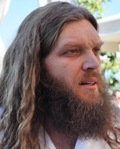
Ervin Hatibi was born in Tirana, Albania, on May 31st 1974. During his childhood he was enrolled in acting courses and lent his voice as a child-actor in the radio dramas of the Albanian Public State Radio. At the age of 14, Ervin Hatibi published his first poems in the literary pages of the main newspapers of the epoch. His first poetry collection “Përditë Shoh Qiellin”, Tirana, Albania, prefaced by Ismail Kadare, was published in 1989 when he was only 15 and was widely acclaimed by the critics. At that time, following the sudden notoriety of the young author, the National Film Studios of Albania “Shqiperia e Re”, produced a documentary film on his works, entitled “The 15 Year Old Poet”.
His first painting exhibition was held in spring 1991 at the National Gallery of Fine Arts. In 1992, while finishing up his studies at the School of Foreign Languages “Asim Vokshi” in Tirana, Ervin Hatibi co-founded the literary avant-garde magazine “e per-7-shme”. In the ensuing years, he wrote extensively on matters of social and literary import, and also actively took part in youth movements, which preceded the democratic changes in his country. He wrote memorable lyrics for well-known pop singers and bands in Tirana, and had his own share of rock scene with his band, as a front man.
Having finished his studies in Albanian Literature & Language at the University of Tirana, and before moving to Jordan with the purpose of studying the Arabic language and civilisation, Ervin Hatibi published his second and most notorious poetry collection “6”, Tirana, 1995. From that point on his poetry was published in various anthologies on major Albanian poets: Anthology of Albanian Poetry, in Macedonian, Macedonia, 1998, Anthology of Contemporary Italian and Albanian Poetry, in Italian & Albanian, Italy, 1998, Three Albanian Poets, in Spanish, Spain, 2003, Frightening and Beautiful, in Albanian, Kosovo, 2003.
His most recent collection of poems, “Pasqyra e Lëndës” [Table of Contents], came out in 2004 in Albania.
Along the years Ervin Hatibi’s writing has progressively intensified in the genre of essays. He has periodically written and published articles and essays in all major newspapers and magazines in Albanian language: the leading Albanian newspaper “Shekulli” and the historical Albanian Macedonian magazine “Lobi”, but not only. “Bota Shqiptare”, in Italy and “Fjala”, in Albania, have also frequently been tribunes of his writings. Ervin Hatibi has written in length on issues related to culture, religion and arts and has participated in writing, but not only, in the social and the political debates of our complex times. By end of the year 2000, he became the editor in chief of “Drita Islame” Magazine [Light of Islam], the official magazine of the Muslim Community of Albania, a position from which he resigned in 2003.
His collection of essays, “Republick of Albanania”, Albania, 2005, is a colourful collage of some of his best essays written during this past decade.
As the television era has continuously gained more and more terrain, Ervin Hatibi has growingly participated in important interventions and debates on contemporary issues in relation to social matters, and more particularly in culture and religion. For the most part, the debates and the interventions have been conducted by leading Albanian television channels, such as “Klan”, “Arbëria”, “Top Channel” and “Vizion Plus”, but many of them have been led by the leading television channels of Greece, Austria, Italy, etc., and also by important news broadcasting agencies, such as Associated Press, Reuters, and Radio France International, BBC among many others.
In the meanwhile, what has particularly enchanted Ervin Hatibi during all these years has been his growing need to communicate through painting. Although Ervin Hatibi’s first collages coincide with his first poems, painting remained his hidden mistress for several years. Upon his return from Jordan, painting progressively started to enflame his imagination and became a strong mean of communication. These last years have been unprecedented in his painting career. Ervin Hatibi has shown in remarkable exhibitions, such as: “Albanie, Printemps-Eternitée 2003”, Paris 2003, “Pop-Ferman”, Ferrara 2004 and “f&rman”, Skopje 2004, “fast forwarding fermans”, Istanbul 2008, and only very recently he was called upon by the National Gallery of Fine Arts and the Ministry of Culture of Albania to curate the yearly international visual arts contest “Onufri ‘07”, Albania’s most important visual art event, which takes place in the premises of the National Gallery of Fine Arts in Tirana. At present, Ervin Hatibi lives and works between Tirana and Instanbul.
ervin.hatibi@gmail.com
 English
  Spanish